Producing the /r/ Sound

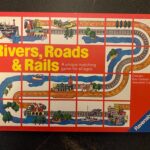
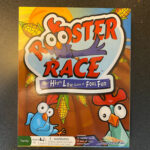
When I’m doing therapy focusing on a specific sound, for example /r/, I will choose a game that contains the sound. Here are some of my favorites for /r/. Even the name of the game gives opportunities use the sound. (Once they master the sound, I notice they are very proud to ask if we’re going to play Rooster Race today.) 


When introducing how to produce /r/, it is helpful for the student to understand where to put their tongue, teeth, and lips.  Describe placement.  Use visual aids like mirrors or a spoon to feel where the tongue belongs.  A drawing of the tongue and teeth may also be helpful in visualizing where to place the tongue.One way to approximate placement is to start with another sound and then shift to the /r/ sound.  Imitating a wolf/coyote sound gets their attention.  Start with an ‘ah’ sound. Then slide into a roo sound for “ahroo.” Eventually drop off the initial sound and try producing just the “ar” sound. 

Using  words containing /gr/ and /kr/ blends may help in getting better placement.   Reinforce growling  when saying words starting with /gr/ or /kr/.

Practice these /kr/ words: crane, crush, crate, crease, cream, creak, creep, cry, crime.

Practice these /gr/ words: great, greet, grit, groan, grow, grape, grade, grip, grin, and grid.

Another way to approximate placement for /r/.   Start with “sh.”  Drop the back of your tongue and turn on your motor.  Your tongue should curl slightly up at the sides.

Using a small spoon can help approximate placement for /r/.  Put the spoon just inside of mouth.  Practice curling tongue around the bowl of the spoon.  Practice producing /r/.

Reinforce rounding the lips.  Saying “oo” will help getting lips in position. That will help approximate overall lip placement for /r/.
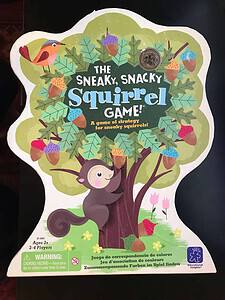
The Sneaky, Snarky Squirrel Game

 Sneaky, Snacky Squirrel is a great therapy game for speech therapy, occupational therapy, physical therapy, and special education.  The Sneaky Snacky Squirrel Game by Educational Insights comes with a Gameboard, 4 Logs, 20 Acorns (4 each of green, blue, red, yellow and purple), a Squirrel Squeezer, a Spinner and directions. During the game, the therapist can incorporate many objectives into the activity.

Fine Motor: Practice spinning the spinner using just your index finger, going either forwards or backwards. Use your finger and thumb to flick the spinner. Make sure the child is holding the spinner down with the other hand to encourage using two hands together. Have the child use the squirrel squeezer to pick up the acorn of the color that they spun on the spinner. Reinforce using one hand, modeling how to hold the squirrel squeezer on the top of the squirrel’s body. Have the child match the colored acorn to the same colored ring on the tree. When cleaning up the game, have the child pick up given colored acorns using a pincer grip and hold the bag in the other hand; reinforce crossing the midline as they put them away.

Gross Motor: Reinforce sitting position for improved stability. Practice midline activities. Have the child reach across their body to pick up the squirrel squeezer or spin the spinner. The therapist can also place the gameboard at a distance. In order to take a turn, the child has to do a gross motor movement (jumping, hopping, standing on one foot, walking like a given animal). 

Special Education Practice following the directions. Have the child spin the spinner and retell you what the space they landed on means. See if they follow the direction according to the spinner. Have the child label colors and match colors. Have the child sort acorns by color. Have them count how many purple acorns they have (do this for each color). Ask questions like if you have 5 red acorns and you have the same amount of blue acorns, how many blue acorns do you have?  Practice concepts like more or less. If I have 3 acorns and you have 4 acorns, who has more? Who has less? Who has the least? Who has the most? Have them count the total number of acorns. If they are older, have them count by 2’s or count by 5’s.   

Speech Therapy: When using this game for speech therapy, cards can be incorporated to practice articulation sounds. Reinforce placement and production for target sounds. Cue the child where the sound is in the word (this has your sound at the end of the word). Depending on their progress, modeling, cueing, or independent production can be used.  After they produce their sound (word, phrase or sentence level), have them spin the spinner. As speech is a motor function, it is important to reinforce trunk stability (appropriate sitting: side, or criss cross), crossing midline and hand use. Following directions can be incorporated by asking questions, what do you do after you say your sound… (spin the spinner, identify where the spinner stopped, pick up the squirrel squeezer, find the correct color acorn and match to the correct ring on the tree). Reinforce color matching and identification. Have the child sort  the acorns by colors. Count how many in each color group. Incorporate concepts like same and different. (Here are 2 blue acorns and 1 red.) Which one is different? Which two are the same. 

These are just some ideas that can be incorporated into a simple game! Happy Therapy!

  Producing the /r/ Sound By  Speech Fairy When I’m doing therapy focusing on a specific sound, for example /r/, I will choose a game that c...