Showing posts with label Occupational Therapy. Show all posts


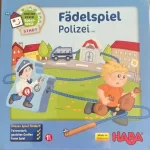
Threading Game

Using games in therapy sessions

Threading Game by HABA is a great fun activity that can be used by occupational therapists, speech & language therapists, and special education teachers.  Games can make therapy fun and engaging for the child while the therapist can elicit responses and actions that meet therapy goals. 

Threading

This is a great, very unusual game from the German manufacturer HABA. This game includes 1 thread with police station, 1 thread with police car, 1 bank, 2 police officers, 1 police dog, 1 thief, 1 stop sign, 1 pr of handcuffs, 1 moneybag, 4 2-sided templates (self-correcting 2 pieces), 1 cloth bag, and instruction booklet.

Suggested lesson for Threading

“Take two matching template pieces and fit them together to make a scene. Look at the template and find the starting place of the scene (left side). Is it the Police station or the Police wagon?  It is the Police station – the building where the police work. Find the block that matches it – it will have yarn and a wooden needle attached.” 

“Now, let’s look at the next image on the template? It is the Stop sign. Find the Stop sign block and, using the needle and yarn, push the needle through the Stop sign block so the yarn goes through.” 

“What is the next image on the template? It is the Police officer. Find the Police officer block and, using the needle and yarn, push the needle through the police officer block so the yarn goes through.”

“What is the next thing that happened in the scene? We see the Thief. Find the Thief block and, using the needle and yarn, push the needle through the Thief block so the yarn goes through adding it to the line.” 

“Let’s compare our thread with the picture shown on the template. Do they look the same?” 

Speech & Language Therapy

  • Practice sequencing from the 2-sided templates
  • Name different kinds of money
  • Name different kinds of dogs

Occupational Therapy

  • Improve motor skills by threading the different pieces together

  • Reinforce midline crossing
  • Reach into the bag and identify the piece you need by feel alone, without peeking
  • Assemble the template with self-correcting halves

Special Education

  • Practice threading in sequence from the template
  • Group pieces by colors
  • Group pieces by kind (people, objects, etc)


Slamwich

Using games in therapy sessions

Slamwich is a great fun activity that can be used by speech & language therapists, occupational therapists, and special education teachers.  Games can make therapy fun and engaging for the child while the therapist can elicit responses and actions that meet therapy goals. 

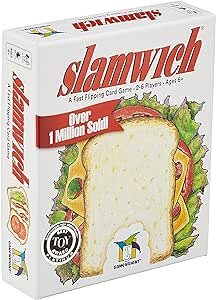
Slamwich

Slamwich is a fast moving card game from Gamewright that can be played by two to six players. Slamwich contains a deck of 55 which include 40 Food cards, 12 Muncher cards, and 3 Thief cards. Slamwich can be played by two to six players for ages six and up.  

How to play Slamwich

Deal an even number of cards to all players. Place the leftover cards in a pile in the center, face up.

Start with the player to the left of the dealer. On their turn, each player quickly flips the top card from their hand onto the center pile. When a player recognizes that a double decker sandwich (two identical cards in a row) or Slamwich (two identical cards separated by one different card) has been built, they slam the pile – putting their hand on top of the pile. The first to slam the pile keeps all the cards.

Watch out for a Thief card or a Muncher card. If there is a Thief card played, you want to slam the pile and say “Stop Thief.” The first one to slam the pile and say “Stop Thief,”  stops the Thief and gets to keep all cards in the pile. 

Muncher cards have a number on them, the next players can play up to this number of cards from their pile in hopes of making a Double Decker or Slamwich, or playing another Muncher or Thief card. If the Muncher is not stopped (by a Slam, a Thief card or another Muncher card), the pile is taken by the player who played the original Muncher card.

If a player slams the pile at any other time, they must place the top card from their pile on the bottom of the center pile and their turn ends.

For children who are able to follow those directions, add another step. You can incorporate vocabulary of the food cards.

If the child is more proficient with sound production, have them use the word in a sentence. Start with a carrier sentence, then go to a more complicated sentence.

If the goals are to improve receptive and expressive language, incorporate WH questions.


Speech & Language Therapy

  • Say the name of the ingredient on the top of the pile
  • Reinforce correct sound production of target sound

Occupational Therapy

  • Reinforce crossing the midline
  • Take and place the cards with appropriate grip

Special Education

  • Count the number of cards in a stack
  • Describe the food item on the card


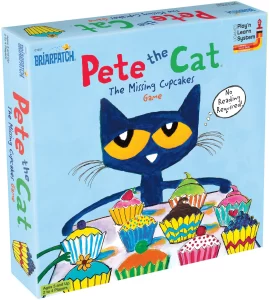
The Missing Cupcakes Game

Using games in therapy sessions

The Missing Cupcakes Game is a great fun activity that can be used by speech & language therapists, occupational therapists, and special education teachers.  Games can make therapy fun and engaging for the child while the therapist can elicit responses and actions that meet therapy goals. 

Missing Cupcakes

The Missing Cupcakes Game has a game board, 14 cupcakes, 20 birthday present cards, 4 character tokens and stands, and a game spinner.

Suggested lesson for The Missing Cupcakes Game

“Today we’re going to play The Missing Cupcakes Game.To setup, pick out a character token and place it on a corner of the game board. Put all the Birthday Present cards face down on the gameboard as a stack. Place all the Cupcakes on Grumpy Toad’s cupcake tray (in the box).”

“It is your turn, so spin the spinner. You spin a 3. Move 3 spaces to a Birthday Present spot. Draw a card and look at it. The Birthday Present is a guitar. Demonstrate through actions a guitar or playing a guitar. If another player guesses correctly, you can move 2 Cupcakes from Grumpy Toad’s Tray to Cupcake Spaces on Pete the Cat’s Birthday Party Table on the game board. Your turn has ended.”

“Now, it is another player’s turn and they spin a 4. Moving 4 spaces they land on an Activity Spot with an Apple on it. They must name a yummy food. If they do this, they can take 1 Cupcake from Grumpy Toad and move it to Pete’s Birthday Present Table.”

“It is my turn and I spin a 3 and land on a Grumpy Toad spot. This allows Grumpy Toad to take back 1 cupcake.”

“The game is won when all the Cupcakes are on Pete the Cat’s Birthday Present Table and Grumpy Toad has no Cupcakes.”

Speech & Language Therapy

  • Practice prepositions (on top of, in front of, next to, etc)
  • Describe the colors of the Cupcakes, Present cards

Occupational Therapy

  • Reinforce crossing the midline
  • Hold your character token with a pincer grip

Special Education

  • Name the colors of the Cupcakes
  • How many animals are on the game board
  • How many cupcakes are on the game board
  • How many balloons are on the game board
  • How many words are on the game board

 Why USED Games are the BEST for Therapy

When I first started out as a therapist, and older colleague always had in her bag a battered old copy of Candy Land. I, on the other hand, was very proud of my new games. I was always combing the catalogs and looking in toy stores for new, interesting yet appropriate games. Then the colleague explained to me about New Car Syndrome.

1. New Car Syndrome. When you spend $20, $30 or $40 on a brand-new game from a store or ordered online, it is like your new car. You are so proud of it. And when the first grumpy child who doesn't feel like doing their best work that day, grabs the cardboard token and BENDS IT IN HALF! You feel like your car has been totaled. It is not the shiny, new car any more. 

If they misbehaved with a game that I'd had for five or ten years, or a game I "inherited" from my predecessor, it wouldn't have wounded me in the same way. So, you have a discussion with them about how that is not nice/they should use their words if they are upset/that is unacceptable behavior and they will be in timeout, or whatever. BUT, my game is no longer the brand-new game it once was. 

2. Used games are kid-tested.  New games may sound interesting to you (as an adult) but kids may be bored with them. Used games have been pre-enjoyed by many different kids so you can be sure there is a universal appeal.

3. Popular/familiar characters at a discount. You don't have to stand in line at Toy Store to get the latest game from the newest Kid Show or latest fad. You can buy Mickey Mouse or Toy Story or Berenstain Bears games used and save your money. If the child is three, Toy Story is a brand-new movie to them, so any game with those characters will be of interest and exciting.

4. Vintage games and discontinued games. You can pick up old games or older versions of classic games that the manufacturer no longer makes. In many cases, they are better games, just not as flashy to parents. When companies "update" their games, they will dumb them down, or take away some of the activities that were beneficial for fine motor skills. (Pop-o-matic dice instead of traditional Rolling Dice.)

5. Four or five used games for the price of one brand new game. If you have a diverse caseload, you are trying to please many kiddos, and very seldom will one game interest all the kids. Some may like dinosaurs, some like unicorns, some like construction trucks, some may like Paw Patrol. Your dollar will go farther picking up four or five games instead of one shiny, brand new game.

6. Don't need four character tokens if you are doing one-on-one therapy. Some used games are not complete. They may be missing a card, a playing token, or a Cootie Bug leg. But, if you are playing a game with one or two kiddos, if the 4-player game is missing one token -- it doesn't matter all that much -- you don't have four players. The game still works.

7. Reuse and Recycle games. Just like in Toy Story 3, we all want to keep Woody out of the landfill. A pre-used game still has many years of use, and to a three-year-old -- it is a new game! -- to them. 

  Producing the /r/ Sound By  Speech Fairy When I’m doing therapy focusing on a specific sound, for example /r/, I will choose a game that c...