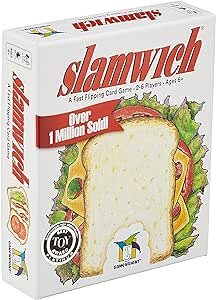
Slamwich

Using games in therapy sessions

Slamwich is a great fun activity that can be used by speech & language therapists, occupational therapists, and special education teachers.  Games can make therapy fun and engaging for the child while the therapist can elicit responses and actions that meet therapy goals. 

Slamwich

Slamwich is a fast moving card game from Gamewright that can be played by two to six players. Slamwich contains a deck of 55 which include 40 Food cards, 12 Muncher cards, and 3 Thief cards. Slamwich can be played by two to six players for ages six and up.  

How to play Slamwich

Deal an even number of cards to all players. Place the leftover cards in a pile in the center, face up.

Start with the player to the left of the dealer. On their turn, each player quickly flips the top card from their hand onto the center pile. When a player recognizes that a double decker sandwich (two identical cards in a row) or Slamwich (two identical cards separated by one different card) has been built, they slam the pile – putting their hand on top of the pile. The first to slam the pile keeps all the cards.

Watch out for a Thief card or a Muncher card. If there is a Thief card played, you want to slam the pile and say “Stop Thief.” The first one to slam the pile and say “Stop Thief,”  stops the Thief and gets to keep all cards in the pile. 

Muncher cards have a number on them, the next players can play up to this number of cards from their pile in hopes of making a Double Decker or Slamwich, or playing another Muncher or Thief card. If the Muncher is not stopped (by a Slam, a Thief card or another Muncher card), the pile is taken by the player who played the original Muncher card.

If a player slams the pile at any other time, they must place the top card from their pile on the bottom of the center pile and their turn ends.

For children who are able to follow those directions, add another step. You can incorporate vocabulary of the food cards.

If the child is more proficient with sound production, have them use the word in a sentence. Start with a carrier sentence, then go to a more complicated sentence.

If the goals are to improve receptive and expressive language, incorporate WH questions.


Speech & Language Therapy

  • Say the name of the ingredient on the top of the pile
  • Reinforce correct sound production of target sound

Occupational Therapy

  • Reinforce crossing the midline
  • Take and place the cards with appropriate grip

Special Education

  • Count the number of cards in a stack
  • Describe the food item on the card


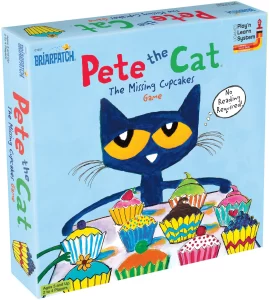
The Missing Cupcakes Game

Using games in therapy sessions

The Missing Cupcakes Game is a great fun activity that can be used by speech & language therapists, occupational therapists, and special education teachers.  Games can make therapy fun and engaging for the child while the therapist can elicit responses and actions that meet therapy goals. 

Missing Cupcakes

The Missing Cupcakes Game has a game board, 14 cupcakes, 20 birthday present cards, 4 character tokens and stands, and a game spinner.

Suggested lesson for The Missing Cupcakes Game

“Today we’re going to play The Missing Cupcakes Game.To setup, pick out a character token and place it on a corner of the game board. Put all the Birthday Present cards face down on the gameboard as a stack. Place all the Cupcakes on Grumpy Toad’s cupcake tray (in the box).”

“It is your turn, so spin the spinner. You spin a 3. Move 3 spaces to a Birthday Present spot. Draw a card and look at it. The Birthday Present is a guitar. Demonstrate through actions a guitar or playing a guitar. If another player guesses correctly, you can move 2 Cupcakes from Grumpy Toad’s Tray to Cupcake Spaces on Pete the Cat’s Birthday Party Table on the game board. Your turn has ended.”

“Now, it is another player’s turn and they spin a 4. Moving 4 spaces they land on an Activity Spot with an Apple on it. They must name a yummy food. If they do this, they can take 1 Cupcake from Grumpy Toad and move it to Pete’s Birthday Present Table.”

“It is my turn and I spin a 3 and land on a Grumpy Toad spot. This allows Grumpy Toad to take back 1 cupcake.”

“The game is won when all the Cupcakes are on Pete the Cat’s Birthday Present Table and Grumpy Toad has no Cupcakes.”

Speech & Language Therapy

  • Practice prepositions (on top of, in front of, next to, etc)
  • Describe the colors of the Cupcakes, Present cards

Occupational Therapy

  • Reinforce crossing the midline
  • Hold your character token with a pincer grip

Special Education

  • Name the colors of the Cupcakes
  • How many animals are on the game board
  • How many cupcakes are on the game board
  • How many balloons are on the game board
  • How many words are on the game board


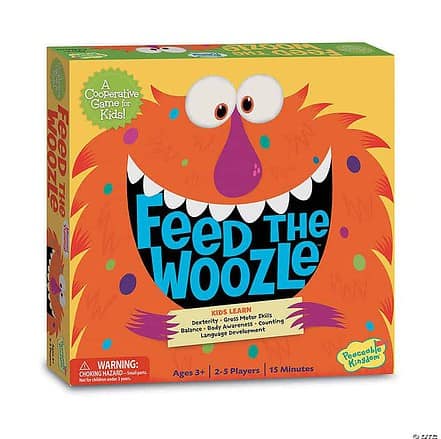
Feed the Woozle

Using games in therapy sessions

Feed the Woozle is a great fun activity that can be used by speech & language therapists, occupational therapists, and special education teachers.  Games can make therapy fun and engaging for the child while the therapist can elicit responses and actions that meet therapy goals. 

Feed the Woozle

Feed the Woozle is a co-operational activity game from Peaceable Kingdom. The game can be played by two to five players playing as a team. The object of the game is to feed the Woozle 12 snacks, carrying the “snacks” on the spoon and depositing them in the Woozle’s mouth, eight-to-ten feet away. For every snack you get in the Woozle’s mouth, collect a Yummy card. Collect 12 Yummy cards before you run out of snacks, and you win! Included in the game: 1 stand-up Woozle, 24 Silly Snack tokens, 12 Yummy cards, 1 die, 1 spoon, and 1 spinner. 

Suggested lesson for Feed the Woozle

“Today we are going to play Feed the Woozle. We need to help the Woozle eat his yummy snacks, so we’re going to carry the snacks over to him using this giant spoon.” 

“The Woozle is over here, with his mouth open. He is about 5 or 6 steps away. Let’s start here and take those steps. Let’s count as we step.”” 

“And to make it fun, we have a spinner that will tell you how to walk from here to there. It can be March, it can be Walk Backwards, it can be Hop like a Bunny. We’ll spin to decide how you do it. So, let’s spin, and it stops on March. Can you show me how you can march?”

“Now, pick up the die and roll it to see how many yummy snack tokens you’ll take over to the Woozle. And you rolled a 2. So, let’s get 2 yummy snacks from the box and put them on the spoon.” 

“Now, let’s march over to the Woozle, holding our spoon and trying not to drop any yummy snacks on the floor. And, when you get there, pour the yummy snacks into the Woozle’s mouth.” 

“One snack fell off, but you got 1 snack in, so you get 1 Yummy card. Now, back to the starting line and it’s our friend’s turn to spin the spinner and roll the die.” 

Speech & Language Therapy

  • Describe the Snack - would you eat it? How would you make it? How would you make it tastier?
  • Describe the Movements listed on the spinner – when would you move that way?

Occupational Therapy

  • Reinforce crossing the midline
  • Roll the dice using two hands to “shake” the dice
  • Roll the dice using one hand
  • Try holding the spoon with different grips: pencil grip, fist grip, etc.

Special Education

  • Count out the snacks and subtract the number that fell off the spoon. Three snacks minus one that fell on the floor = 2 snacks.
  • What other silly movements can you think of that are not on the spinner?


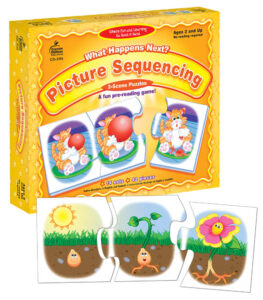
What Happens Next? Picture Sequencing

Using games in therapy sessions

What Happens Next? is a great fun activity that can be used by speech & language therapists, occupational therapists, and special education teachers.  Games can make therapy fun and engaging for the child while the therapist can elicit responses and actions that meet therapy goals. 

What Happens Next? Picture Sequencing

What Happens Next? Picture Sequencing Game from Carson-Dellosa with 14 sets of 3-piece sequence puzzle pictures. The game can be played with one player for ages three and up.

Suggested lesson for What happens Next?

Pre-select the 3-piece puzzle. Take it apart and present the pieces in a jumbled order. For this sample, we will use the “Puppy on the Slide” sequence.

“We’re going to put together a story puzzle. The pictures on the puzzle tell us what happened to each character. Let’s look at the pieces.”

“Tell me what is going on in this piece? Yes, the puppy is at the top of the slide.”

“What is going on in this piece? Yes, the puppy is standing next to the slide and he is wagging his tail.”

“And what is going on in this last piece? Yes, the puppy is sliding down the slide.”

“Let’s put them in an order that makes sense. Would you be at the top or bottom of the slide before you slide down.”

“Yes, you would be at the top. Let’s put those pieces together. They fit together.”

“Let’s look at the last piece. The puppy is at the bottom of the slide wagging his tail. He is happy, he wants to slide down the slide. Let’s fit the piece to the side of the other two pieces. It fits.”

For children who are able to follow those directions, you can add another step. You can incorporate vocabulary cards or articulation cards. If you are working on particular sounds, reinforce the correct placement and production of the sounds.

If the child is more proficient with sound production, have them use the word in a sentence. 

Start with a carrier sentence, such as: “I see a puppy.” As they are successful, go to a more complicated sentence, such as: “The puppy likes to ride the slide.”

If the goals are to improve receptive and expressive language, incorporate WH questions about the sequence cards.

Speech & Language Therapy

  • Describe what is happening in the puzzle picture
  • Describe the place where this is happening

Occupational Therapy

  • Use two hands together to manipulate the pieces and put them together
  • Reinforce crossing the midline

Special Education

  • Name a word that rhymes with the animal or item on the cards
  • Where would you expect to find the animal
  • What sound would the animal make


 Why USED Games are the BEST for Therapy

When I first started out as a therapist, and older colleague always had in her bag a battered old copy of Candy Land. I, on the other hand, was very proud of my new games. I was always combing the catalogs and looking in toy stores for new, interesting yet appropriate games. Then the colleague explained to me about New Car Syndrome.

1. New Car Syndrome. When you spend $20, $30 or $40 on a brand-new game from a store or ordered online, it is like your new car. You are so proud of it. And when the first grumpy child who doesn't feel like doing their best work that day, grabs the cardboard token and BENDS IT IN HALF! You feel like your car has been totaled. It is not the shiny, new car any more. 

If they misbehaved with a game that I'd had for five or ten years, or a game I "inherited" from my predecessor, it wouldn't have wounded me in the same way. So, you have a discussion with them about how that is not nice/they should use their words if they are upset/that is unacceptable behavior and they will be in timeout, or whatever. BUT, my game is no longer the brand-new game it once was. 

2. Used games are kid-tested.  New games may sound interesting to you (as an adult) but kids may be bored with them. Used games have been pre-enjoyed by many different kids so you can be sure there is a universal appeal.

3. Popular/familiar characters at a discount. You don't have to stand in line at Toy Store to get the latest game from the newest Kid Show or latest fad. You can buy Mickey Mouse or Toy Story or Berenstain Bears games used and save your money. If the child is three, Toy Story is a brand-new movie to them, so any game with those characters will be of interest and exciting.

4. Vintage games and discontinued games. You can pick up old games or older versions of classic games that the manufacturer no longer makes. In many cases, they are better games, just not as flashy to parents. When companies "update" their games, they will dumb them down, or take away some of the activities that were beneficial for fine motor skills. (Pop-o-matic dice instead of traditional Rolling Dice.)

5. Four or five used games for the price of one brand new game. If you have a diverse caseload, you are trying to please many kiddos, and very seldom will one game interest all the kids. Some may like dinosaurs, some like unicorns, some like construction trucks, some may like Paw Patrol. Your dollar will go farther picking up four or five games instead of one shiny, brand new game.

6. Don't need four character tokens if you are doing one-on-one therapy. Some used games are not complete. They may be missing a card, a playing token, or a Cootie Bug leg. But, if you are playing a game with one or two kiddos, if the 4-player game is missing one token -- it doesn't matter all that much -- you don't have four players. The game still works.

7. Reuse and Recycle games. Just like in Toy Story 3, we all want to keep Woody out of the landfill. A pre-used game still has many years of use, and to a three-year-old -- it is a new game! -- to them. 


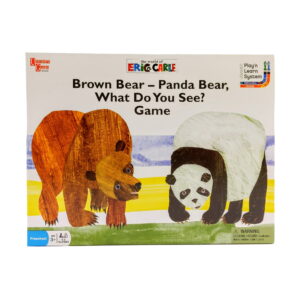
Brown Bear, Panda Bear What Do You See?

Using games in therapy sessions

Brown Bear, Panda Bear, What Do You See? is a great fun activity that can be used by speech & language therapists, occupational therapists, and special education teachers.  Games can make therapy fun and engaging for the child while the therapist can elicit responses and actions that meet therapy goals. 

Brown Bear, Panda Bear What Do You See?

Brown Bear, Panda Bear What Do You See? is a Sequence Matching Game from University Games with 36 cards, a game board, and instructions. The game can be played with two to four players.

Suggested lesson for Brown Bear, Panda Bear

Lay the four bear cards, face down on the game board. 

“We both pick a card to see what bear we are. You picked a Brown Bear. You sit here with the picture of the Brown Bear. And I picked a Panda Bear, so I will sit here.”

Lay the other 32 animal cards face down in the center of the game board. 

“It is your turn, so you pick a card from the middle. Turn the card over so we both can see it. What is it?”

“Yes, it is a Green Frog. Let’s look at your animals on the board. Do you see a Green Frog? Yes, there is a Green Frog. The Green Frog on the card and the Green Frog on the board – they match. Green Frog and Green Frog. They are the same. So let’s put the Green Frog card on top of the Green Frog picture.”

“Because you got a match, you can pick another card. Turn the card over so we both can see it. What is it?”

“Yes, it is a Red Wolf. Let’s look at the animals on the board in front of you. Do you see a Red Wolf? No, there is not a Red Wolf. (But, there is a Red Wolf for the Panda Bear.) So, let’s put the Red Wolf back in the middle, face down.”

“Now, it is my turn. I remember that you picked a Red Wolf. So, I pick this card and show it so we both can see. It is a Red Wolf and it matches the Red Wolf on the board. The Red Wolf and the Red Wolf are the same – they match. So, I put the Red Wolf on top of the Red Wolf on my side of the game board.”

“Because I got a match by remembering where the Red Wolf card was, I can pick another card. So, I pick a card and turn it over so we both can see it. It is a Yellow Duck. I’m looking at my animals, but I don’t see a Yellow Duck. Do you see a Yellow Duck anywhere?”

“Because I didn’t get a match, I put the Yellow Duck back face down in the middle where I picked it from.”

“Now, it is your turn to pick a card. You can pick any card from the middle. Do you remember where the yellow Duck card is…”

Play continues until one player has collected all the animal cards in their sequence on the game board.

If a player has matched all 8 cards in their sequence:

  • If playing as a Brown Bear, recite:
    “Brown Bear, Brown Bear What Do You See? I see a Red Bird, I see a Yellow Duck, I see a Blue Horse, I see a Green Frog, I see a Purple Cat, I see a White Dog, I see a Black Sheep, I see a Goldfish… Looking at me!”
  • If playing as a Panda Bear, recite:
    “Panda Bear, Panda Bear What Do You See? I see a Bald Eagle, I see a Water Buffalo, I see a Spider Monkey, I see a Green Sea Turtle, I see a Macaroni Penguin, I see a Sea Lion, I see a Red Wolf, I see a Black Panther… Wild and Free!”

For children who are able to follow those directions, you can add another step. You can incorporate vocabulary cards or articulation cards. If you are working on particular sounds, reinforce the correct placement and production of the sounds.

If the child is more proficient with sound production, have them use the word in a sentence. 

Start with a carrier sentence, such as: “I see a Brown Bear.” As they are successful, go to a more complicated sentence, such as: “The Brown Bear lives in the woods.”

If the goals are to improve receptive and expressive language, incorporate WH questions about the animal cards, for example: Where does [this animal] live? What does [this animal] like to do?

Speech & Language Therapy

  • Name a word that rhymes with the animal or color
  • Where would you expect to find the animal

Occupational Therapy

  • Pick up and turn over cards with appropriate grip
  • Reinforce midline crossing

Special Education

  • Name a word that rhymes with the animal or color
  • Where would you expect to find the animal
  • What sound would the animal make

Tutti Frutti

Tutti Frutti is a favorite activity that I use with many of my school-age kiddoes. This is a great activity used in conjunction with emerging math skills. 

Tutti Frutti

Tutti Frutti is a card game from Discovery Toys for two to six players, recommended for ages six and up. Tutti Frutti contains 56 playing cards (each card showing a different number of fruits: red strawberries, purple plums, green limes, and yellow bananas, in combinations from one to five) and one steel bell.

The object of the game is to recognize when there are five of one fruit visible. This could be a card that shows, for example, five strawberries. Or it could be the sum of two different cards, for example, two plums on one card and three plums on another card. If you recognize that five fruits are visible, reach to the middle to ring the bell. The first one who rings the bell gets all the cards played.

Suggested lesson for Tutti Frutti

To set up the game, place the bell in the center of the table so all can reach it.  Shuffle the cards and deal out an equal number of cards to each player. All players should place their pile of cards face down in front of them.

"I will go first. I'll turn the top card over and place in front of my pile. You turn the top card of your pile over and place it in front of your pile."

"What do you see on my card? What kind of fruit is it? Yes, it is a Strawberry. And how many Strawberries on my card? Yes, there are one-two-three-four Strawberries on my card."

"Let's look at your card. What is the fruit on your card? Yes, it is a Banana. And how many Bananas on your card? Yes, there are one-two Bananas on your card."

"Do we see five of one kind of fruit showing? Let's look. There are four Strawberries and two Bananas. Are they the same fruits? No, they are not the same fruits, so we both draw new cards."

"What is on my card? Yes, my card has a Lime on it. How many Limes are on my card? Yes, there are one-two Limes on my card."

"Now let's look at your card. What is on your card?"

"Yes, there are Limes on your card. The same are on my card. How many Limes are on your card? Yes, there are one-two-three Limes on your card."

"Our cards have the same fruit on them. They match. Limes and limes."

"How many limes are showing? Two Limes on my card and three Limes on your card. What is three plus two? Yes, it is five. There are five Limes showing. Five is our goal. Ring the bell and collect all the cards showing."

When a player loses all their cards, they are out of the game. The winner is the player who collects all the cards. 

For children who are able to follow these directions, add another step. Incorporate vocabulary cards or articulation cards. If you are working on particular sounds, reinforce the correct placement and production of the sounds.

If the child is more proficient with sound production, have them use the word in a sentence. Start with a carrier sentence, "I like strawberries." Then go to a more complicated sentence, "I put strawberries on my cereal.".

If the goals are to improve receptive and expressive language, incorporate WH questions.

Using games in therapy sessions

Tutti Frutti is a great fun activity that can be used by speech & language therapists, occupational therapists, and special education teachers. 

Incorporate the game play into your therapy session, having kiddoes say their target sounds before moving their token, picking a card, or whatever action the game calls for.

Games can make therapy fun and engaging for the child while the therapist can elicit responses and actions that meet therapy goals. 

Speech & Language Therapy

  • Say the name of the fruit and its color
  • Switch around fruits and colors (would you eat a red banana, would you eat a yellow plum)
  • Say the target sound before playing a card
  • Say the target sound before ringing the bell

Occupational Therapy

  • Reinforce crossing the midline

Special Education

  • Practice simple addition
  • Practice naming fruits and their colors
  • Can you make a rhyme for the fruit
  • Is there part of this fruit that you don’t eat


  Producing the /r/ Sound By  Speech Fairy When I’m doing therapy focusing on a specific sound, for example /r/, I will choose a game that c...