https://m.media-amazon.com/images/I/91yUG40gv0L._AC_SL1500_.jpg


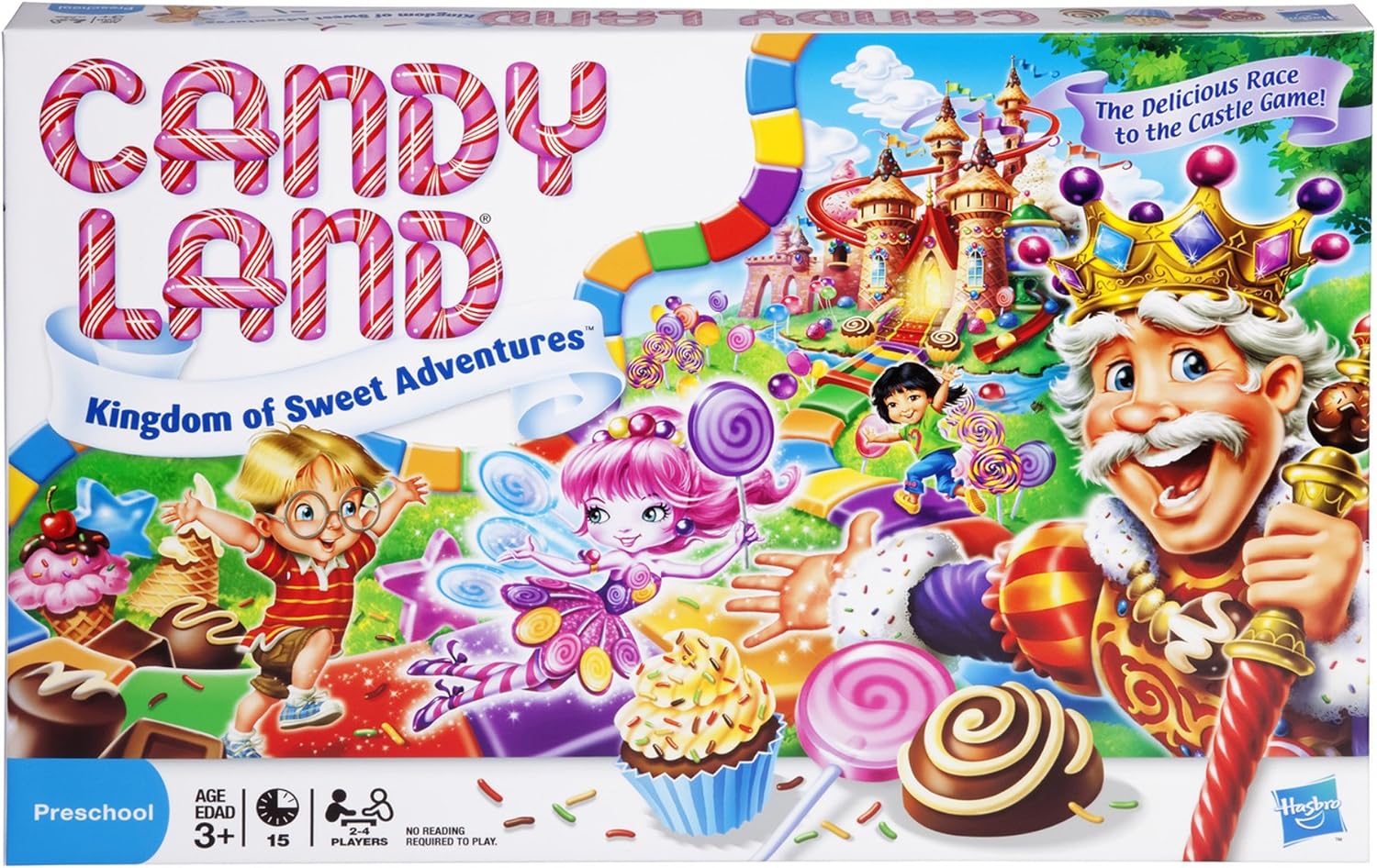
Candy Land was one of the most popular games ever in America. Everyone knows Candy Land, but here are some things about Candy Land that maybe you didn't know. It has its uses as a game for therapy, but is a timeless game that anyone can enjoy. Candy Land has been around for a long time, but there are always more things to learn.

1. Candy Land requires no reading by the players.

Other than the directions that would require an adult or older child, there is no need to read cards for answers or directions. Preschool children can play this game after a rudimentary explaining of the rules.

2. Candy Land sells about one million games per year.

Candy Land has been one of the most popular games in modern times. Candy Land has sold more 50 million games in the 70 years since it was first published. Candy Land has been a perennial favorite of Baby Boomers, GenXers and subsequent generations. 

3. Candy Land's game track is made up of 134 red, blue, yellow, green, orange, purple and pink spaces.

The track is often described a "rainbow colored" though it does not include Indigo and Violet, it does include Purple and Pink.

4. You move by drawing cards with a colored square and you move to the nearest square of that color.

This unique method of moving means reading is not necessary. Children can draw a card and scan the board to see a matching color, which tells them where to put their token. In 2013, new games have a spinner to randomly select a color instead of a deck of color cards.

5. Candy Land was designed by Eleanor Abbott while she was in the hospital recovering from polio. and was first sold by the Milton Bradley company in 1949.

Eleanor Abbott, a school teacher, contracted polio at age 36 and was hospitalized as was the common practice for polio. In the polio ward were several children who spent their days in the grim hospital setting. Eleanor wanted to give the children something to occupy their time during the long endless hours. The home-made game was extremely popular and Eleanor's friends suggested she show the game to the Milton Bradley company. 

6. In 2005, Candy Land was inducted in to The National Toy Hall of Fame at the Strong Museum of Play.

Candy Land was the thirty-second inductee into the National Toy Hall of Fame, and the fourth game inducted (after Monopoly, checkers, and Scrabble).

 

Race to the Roof

Using games in therapy sessions

Race to the Roof is a board game from Ravensberger. The game can be played by two to four players. The object of the game is to be the first player to get from the front door to the attic window. Race to the Roof is a great fun activity that can be used by speech & language therapists, occupational therapists, and special education teachers.  Games can make therapy fun and engaging for the child while the therapist can elicit responses and actions that meet therapy goals. 

Race to the Roof

Race to the Roof includes a game board (in two interlocking pieces), 16 Room cards, 20 Object (chance) cards, 4 playing tokens, game rules, and a die. The room tiles can be arranged in any order you choose. 

Suggested lesson for Race to the Roof

“Today we’re going to play Race to the Roof.”

“Let’s assemble the game board and place the 16 Room cards in the open spaces on the board. And we place the Object cards in a face-down pile.”

“It is your turn. Roll the die. What did you roll? You rolled a four, so move your game token four spaces into the first room.”

“Now it is my turn. I roll a three. I move three spaces.”

“It is your turn again. Roll the die. You roll a six. When you roll a six, you get to pick a card from the pile of Object cards.”

“Your card is the Jam Jar. Look at the different rooms for a Jam Jar. It is in the Kitchen on top of the Refrigerator. You can move your token to the red circle on the Kitchen room card.”

To win the game, the player must roll the exact number on the die to match the spaces remaining to reach the Attic window.

Speech & Language Therapy

  • Practice prepositions (on top of, in front of, next to, etc) when describing the different rooms
  • Identify an object and describe its appearance
  • Describe its use (function)
  • Locate and name the room that contains the object
  • Explain why that object is in that room

Occupational Therapy

  • Reinforce midline crossing
  • Roll the die using two hands to “shake” the die
  • Move the token landing on every circle, counting as you go

Special Education

  • If you roll a four (for example), count out loud one, two, three, four as you land on each circle
  • When you draw an object card, what color is the object?
  • What would you do with this object?
  • Would you have more than one of this object?


1, 2, 3, 4-Bean Salad

Cooking and baking are great ways to interact with your children. It is a way to spend time together, develop appropriate skills, and, of course, have a finished product. There are many emerging skills that can be incorporated into cooking and baking.

Some ground rules for cooking with children

1. Be consistent. Children learn best from consistency.  It teaches them what to expect. 

2. Limit your time. Don’t make it long and tedious. Children do not have the same attention span as adults.  Younger children (3-6) are less focused than older children (7-10). 

3. Stop if either you or your child becomes bored or frustrated; otherwise, this will become a dreaded time. Inform your child of the estimated time so they will have appropriate expectations. “This will take us 15 minutes to put together.” Before you begin, have all of your ingredients ready so you can keep within expectations.

4. Get your child’s attention before you speak and give them your full attention when s/he speaks. Have your child repeat the direction back to you to make sure they heard and processed the information.

5. Talk about what you are doing (self talk) and what your child is doing (parallel talk). An example of self-talk would be “I am mixing the butter and sugar together.” An example of parallel talk would be “you are cracking the eggs.” 

6. Use short phrases. “Count out 2 eggs” or “Unwrap one stick of butter”

7. Repeat key words and phrases.

8. Expand on your child’s comments by adding comments of your own. “The broccoli is green.” “Yes, the broccoli is green and has a bumpy texture.”

9. Make statements about similarities and differences as they come up.
“The flour and sugar are both white.”
“The egg shell is white and hard and the flour is white and soft.” 

10. Explain cause and effect.
“When butter melts it goes from a solid to a liquid.”
“Touch a hot stove and you can burn your finger.”

1, 2, 3, 4-BEAN SALAD

Ingredients

1 can wax beans

1 can green beans

1 can chick peas

1 can kidney beans

1 small red onion

Italian dressing

Directions

Open all cans, drain liquid, and empty into a bowl.

Reinforce using two hands to open the cans and mix in the bowl.

Cut up onion and toss with the beans.

Have your child describe how the beans are alike and different.

Mix well.

Reinforce using two hands: working hand and helper hand.

Toss with Italian dressing and mix well.

Use a wooden spoon to stir and mix thoroughly.

Cover and refrigerate.

The activities suggested here are designed to reinforce in children some very basic skills. This is not intended as a substitute for therapy by licensed therapists. If you have concerns about your child’s physical or language development, consult your pediatrician or a licensed therapist in your area.

Supervise your child when using sharp knives and other potentially dangerous utensils.

© 2012  The Therapist's Cookbook by Jacqueline Messineo-Cowles


Slamwich

Using games in therapy sessions

Slamwich is a great fun activity that can be used by speech & language therapists, occupational therapists, and special education teachers.  Games can make therapy fun and engaging for the child while the therapist can elicit responses and actions that meet therapy goals. 

Slamwich

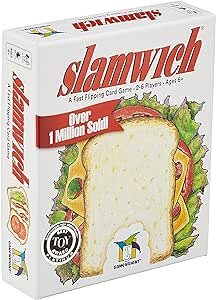
Slamwich is a fast moving card game from Gamewright that can be played by two to six players. Slamwich contains a deck of 55 which include 40 Food cards, 12 Muncher cards, and 3 Thief cards. Slamwich can be played by two to six players for ages six and up.  

How to play Slamwich

Deal an even number of cards to all players. Place the leftover cards in a pile in the center, face up.

Start with the player to the left of the dealer. On their turn, each player quickly flips the top card from their hand onto the center pile. When a player recognizes that a double decker sandwich (two identical cards in a row) or Slamwich (two identical cards separated by one different card) has been built, they slam the pile – putting their hand on top of the pile. The first to slam the pile keeps all the cards.

Watch out for a Thief card or a Muncher card. If there is a Thief card played, you want to slam the pile and say “Stop Thief.” The first one to slam the pile and say “Stop Thief,”  stops the Thief and gets to keep all cards in the pile. 

Muncher cards have a number on them, the next players can play up to this number of cards from their pile in hopes of making a Double Decker or Slamwich, or playing another Muncher or Thief card. If the Muncher is not stopped (by a Slam, a Thief card or another Muncher card), the pile is taken by the player who played the original Muncher card.

If a player slams the pile at any other time, they must place the top card from their pile on the bottom of the center pile and their turn ends.

For children who are able to follow those directions, add another step. You can incorporate vocabulary of the food cards.

If the child is more proficient with sound production, have them use the word in a sentence. Start with a carrier sentence, then go to a more complicated sentence.

If the goals are to improve receptive and expressive language, incorporate WH questions.


Speech & Language Therapy

  • Say the name of the ingredient on the top of the pile
  • Reinforce correct sound production of target sound

Occupational Therapy

  • Reinforce crossing the midline
  • Take and place the cards with appropriate grip

Special Education

  • Count the number of cards in a stack
  • Describe the food item on the card


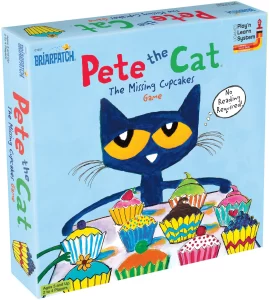
The Missing Cupcakes Game

Using games in therapy sessions

The Missing Cupcakes Game is a great fun activity that can be used by speech & language therapists, occupational therapists, and special education teachers.  Games can make therapy fun and engaging for the child while the therapist can elicit responses and actions that meet therapy goals. 

Missing Cupcakes

The Missing Cupcakes Game has a game board, 14 cupcakes, 20 birthday present cards, 4 character tokens and stands, and a game spinner.

Suggested lesson for The Missing Cupcakes Game

“Today we’re going to play The Missing Cupcakes Game.To setup, pick out a character token and place it on a corner of the game board. Put all the Birthday Present cards face down on the gameboard as a stack. Place all the Cupcakes on Grumpy Toad’s cupcake tray (in the box).”

“It is your turn, so spin the spinner. You spin a 3. Move 3 spaces to a Birthday Present spot. Draw a card and look at it. The Birthday Present is a guitar. Demonstrate through actions a guitar or playing a guitar. If another player guesses correctly, you can move 2 Cupcakes from Grumpy Toad’s Tray to Cupcake Spaces on Pete the Cat’s Birthday Party Table on the game board. Your turn has ended.”

“Now, it is another player’s turn and they spin a 4. Moving 4 spaces they land on an Activity Spot with an Apple on it. They must name a yummy food. If they do this, they can take 1 Cupcake from Grumpy Toad and move it to Pete’s Birthday Present Table.”

“It is my turn and I spin a 3 and land on a Grumpy Toad spot. This allows Grumpy Toad to take back 1 cupcake.”

“The game is won when all the Cupcakes are on Pete the Cat’s Birthday Present Table and Grumpy Toad has no Cupcakes.”

Speech & Language Therapy

  • Practice prepositions (on top of, in front of, next to, etc)
  • Describe the colors of the Cupcakes, Present cards

Occupational Therapy

  • Reinforce crossing the midline
  • Hold your character token with a pincer grip

Special Education

  • Name the colors of the Cupcakes
  • How many animals are on the game board
  • How many cupcakes are on the game board
  • How many balloons are on the game board
  • How many words are on the game board


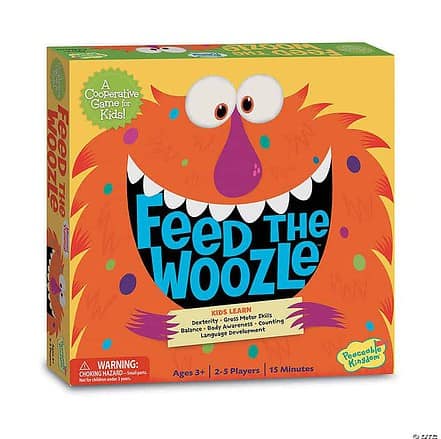
Feed the Woozle

Using games in therapy sessions

Feed the Woozle is a great fun activity that can be used by speech & language therapists, occupational therapists, and special education teachers.  Games can make therapy fun and engaging for the child while the therapist can elicit responses and actions that meet therapy goals. 

Feed the Woozle

Feed the Woozle is a co-operational activity game from Peaceable Kingdom. The game can be played by two to five players playing as a team. The object of the game is to feed the Woozle 12 snacks, carrying the “snacks” on the spoon and depositing them in the Woozle’s mouth, eight-to-ten feet away. For every snack you get in the Woozle’s mouth, collect a Yummy card. Collect 12 Yummy cards before you run out of snacks, and you win! Included in the game: 1 stand-up Woozle, 24 Silly Snack tokens, 12 Yummy cards, 1 die, 1 spoon, and 1 spinner. 

Suggested lesson for Feed the Woozle

“Today we are going to play Feed the Woozle. We need to help the Woozle eat his yummy snacks, so we’re going to carry the snacks over to him using this giant spoon.” 

“The Woozle is over here, with his mouth open. He is about 5 or 6 steps away. Let’s start here and take those steps. Let’s count as we step.”” 

“And to make it fun, we have a spinner that will tell you how to walk from here to there. It can be March, it can be Walk Backwards, it can be Hop like a Bunny. We’ll spin to decide how you do it. So, let’s spin, and it stops on March. Can you show me how you can march?”

“Now, pick up the die and roll it to see how many yummy snack tokens you’ll take over to the Woozle. And you rolled a 2. So, let’s get 2 yummy snacks from the box and put them on the spoon.” 

“Now, let’s march over to the Woozle, holding our spoon and trying not to drop any yummy snacks on the floor. And, when you get there, pour the yummy snacks into the Woozle’s mouth.” 

“One snack fell off, but you got 1 snack in, so you get 1 Yummy card. Now, back to the starting line and it’s our friend’s turn to spin the spinner and roll the die.” 

Speech & Language Therapy

  • Describe the Snack - would you eat it? How would you make it? How would you make it tastier?
  • Describe the Movements listed on the spinner – when would you move that way?

Occupational Therapy

  • Reinforce crossing the midline
  • Roll the dice using two hands to “shake” the dice
  • Roll the dice using one hand
  • Try holding the spoon with different grips: pencil grip, fist grip, etc.

Special Education

  • Count out the snacks and subtract the number that fell off the spoon. Three snacks minus one that fell on the floor = 2 snacks.
  • What other silly movements can you think of that are not on the spinner?


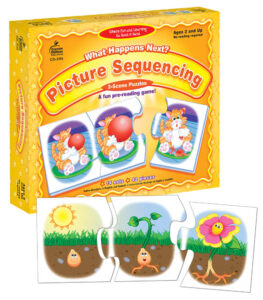
What Happens Next? Picture Sequencing

Using games in therapy sessions

What Happens Next? is a great fun activity that can be used by speech & language therapists, occupational therapists, and special education teachers.  Games can make therapy fun and engaging for the child while the therapist can elicit responses and actions that meet therapy goals. 

What Happens Next? Picture Sequencing

What Happens Next? Picture Sequencing Game from Carson-Dellosa with 14 sets of 3-piece sequence puzzle pictures. The game can be played with one player for ages three and up.

Suggested lesson for What happens Next?

Pre-select the 3-piece puzzle. Take it apart and present the pieces in a jumbled order. For this sample, we will use the “Puppy on the Slide” sequence.

“We’re going to put together a story puzzle. The pictures on the puzzle tell us what happened to each character. Let’s look at the pieces.”

“Tell me what is going on in this piece? Yes, the puppy is at the top of the slide.”

“What is going on in this piece? Yes, the puppy is standing next to the slide and he is wagging his tail.”

“And what is going on in this last piece? Yes, the puppy is sliding down the slide.”

“Let’s put them in an order that makes sense. Would you be at the top or bottom of the slide before you slide down.”

“Yes, you would be at the top. Let’s put those pieces together. They fit together.”

“Let’s look at the last piece. The puppy is at the bottom of the slide wagging his tail. He is happy, he wants to slide down the slide. Let’s fit the piece to the side of the other two pieces. It fits.”

For children who are able to follow those directions, you can add another step. You can incorporate vocabulary cards or articulation cards. If you are working on particular sounds, reinforce the correct placement and production of the sounds.

If the child is more proficient with sound production, have them use the word in a sentence. 

Start with a carrier sentence, such as: “I see a puppy.” As they are successful, go to a more complicated sentence, such as: “The puppy likes to ride the slide.”

If the goals are to improve receptive and expressive language, incorporate WH questions about the sequence cards.

Speech & Language Therapy

  • Describe what is happening in the puzzle picture
  • Describe the place where this is happening

Occupational Therapy

  • Use two hands together to manipulate the pieces and put them together
  • Reinforce crossing the midline

Special Education

  • Name a word that rhymes with the animal or item on the cards
  • Where would you expect to find the animal
  • What sound would the animal make


  Producing the /r/ Sound By  Speech Fairy When I’m doing therapy focusing on a specific sound, for example /r/, I will choose a game that c...